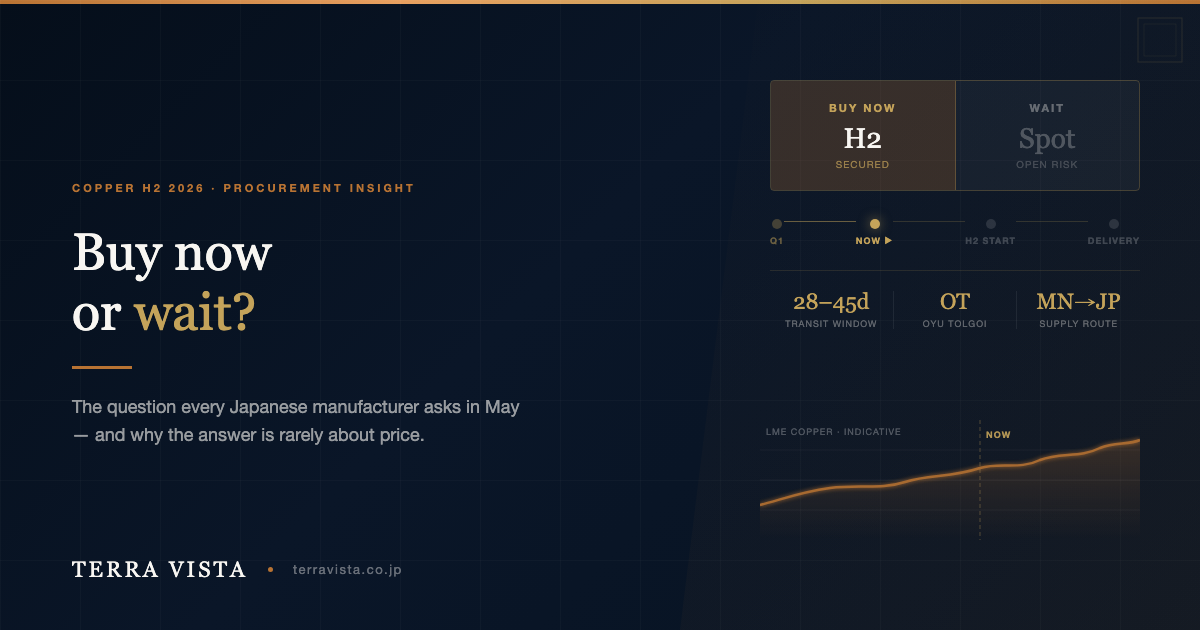
H2 2026 Copper Contracts: Buy Now or Wait?
Every procurement cycle has a decision window. For copper concentrate, that window for H2 2026 supply is open now — and the supply-side signals suggest it will narrow faster than in previous cycles.
Here is a structured look at the timing question: what the “wait” argument assumes, what the “buy now” argument is actually based on, and what a practical decision framework looks like for Japan-based manufacturers and trading companies.
The Setup: Where the Market Stands
As of Q2 2026, LME copper spot is trading at approximately $10,100/MT — up 8.3% month-on-month and 25% year-on-year.
🟡 LME spot: MetalCharts/MINING.COM, May 2026
Pan Pacific Copper, Japan’s largest supplier of refined copper, offered domestic customers a record premium of $330 per tonne for 2026 — more than three times the 2025 figure of $88, paid on top of the benchmark LME price. The figure was reported by Reuters on a company source, and it is the premium on refined metal, not on concentrate; treat it as market context for concentrate buyers rather than a concentrate price (Reuters via MINING.COM, 9 January 2026).
These two numbers together tell the same story: Japanese buyers are already paying more for copper, and the competition for reliable supply is intensifying at the upstream level.
The procurement timing question — buy H2 supply now or wait — is not an abstract market call. It is a structural question about how copper concentrate supply chains work and what the realistic alternatives are at different points in the year.
How Copper Concentrate Procurement Actually Works
Unlike refined copper traded at LME, copper concentrate is procured through negotiated supply relationships. The key mechanics:
Annual benchmarks set the TC/RC baseline. Treatment and refining charges are negotiated annually between major producers and smelters. For 2026 the usual single benchmark did not settle cleanly: Pan Pacific Copper and Lundin Mining provisionally agreed to roll 2025 terms over broadly flat, TC/RCs had already fallen to record lows in the 2025 annual deals, and Freeport-McMoRan said it planned to break away from the benchmark system altogether (Bloomberg via MINING.COM, 11 December 2025). We do not have a verified settled 2026 China-Japan benchmark figure to quote.
Low TC/RC = smelters are squeezed. When smelters have abundant feedstock, they charge more for processing (higher TC/RC). When they compete for concentrate supply, they accept lower charges. Reporting on the 2026 round attributes the collapse in TC/RCs to two things at once — a run of mine outages and an over-expansion of global refining capacity — so read low TC/RC as a signal of upstream tightness.
Supply is relationship-allocated before it reaches spot. Producers like Oyu Tolgoi (OT) commit volumes to long-standing buyers in Q1-Q2 for the following contract period. Once committed, that volume is no longer available at spot. Buyers who rely on the spot market in Q3 are purchasing from volumes that were not fully allocated — and those volumes carry risk (specification variability, shorter delivery windows, less predictable documentation).
The practical implication: by the time a buyer in Q3 decides they “waited long enough,” the best-quality, most reliable supply has already been allocated.
The “Wait” Argument — and Its Assumptions
Buyers who choose to wait through Q2 typically make one or more of the following assumptions:
- LME prices will pull back — reducing the effective cost of copper feedstock
- Spot availability will improve — freeing up volume for later negotiation
- Alternative sources will emerge — providing optionality not currently visible
Each of these assumptions deserves scrutiny.
On LME price pullback: Copper prices are being supported by multiple structural drivers simultaneously: Chinese strategic stockpiling, EV and power-grid infrastructure build-out, and the US-Japan Critical Minerals Action Plan (signed March 2026). These are not speculative forces. They are policy-backed demand signals with multi-year lead times. A cyclical pullback is possible; a structural reversal is not in the base case for H2 2026.
On spot availability improving: The OT underground mine ramp-up is adding volume to the market — but that volume is being absorbed by Chinese smelters under existing allocation agreements. New volume entering the spot market depends on producers choosing to sell spot rather than extend existing relationships. There is no structural reason to expect this in 2026.
Rio Tinto states that Oyu Tolgoi is expected to produce around 500,000 tonnes of copper per year on average from 2028 to 2036, from the open pit and underground combined, and around 290,000 tonnes a year averaged over the roughly 30-year reserve life (Rio Tinto, Oyu Tolgoi underground production release). The 500,000-tonne figure is a 2028–2036 average, not a 2026 rate.
On alternative sources: Buyers who are not currently in active negotiation with Mongolian producers — and do not have an intermediary relationship — face a 2-4 month timeline to establish the documentation, counterparty verification, and logistics coordination needed to begin a new supply relationship. Starting that process in Q3 means Q4 at the earliest for actual supply. H2 has already passed by then.
The “Buy Now” Argument — What It Is Actually Based On
Securing H2 2026 supply in Q2 is not a bet on prices moving higher. It is a decision to remove supply-chain risk from the equation.
Specifically:
1. Allocation timing. OT volumes and equivalent Mongolia-origin concentrates are being committed now. The buyers in active negotiation today have first access to supply that matches their specification requirements. Waiting shifts the available pool toward residual volumes.
2. TC/RC leverage. In a tight-concentrate environment, buyers who are negotiating now have more leverage on TC/RC terms than buyers negotiating under time pressure in Q3. This is a cost-efficiency argument, not just a supply-availability one.
3. Documentation and logistics lead time. Mongolia-Japan logistics via the Trans-Mongolian rail corridor run 28–45 days under normal conditions. 🟡 (Operational estimate based on known Trans-Mongolian route parameters.) Factoring in pre-shipment inspection, customs documentation, and Japanese import compliance — the effective lead time from “signed contract” to “delivered concentrate at Japanese port” is typically 60–90 days. H2 delivery starts in July. Working backwards: a contract signed in late May or early June supports July-August delivery. A contract signed in August supports October delivery at earliest.
4. Japan import compliance. Japan’s import regulations for copper concentrate involve a specific set of documentation requirements: certificate of analysis, country of origin declaration, REACH compliance records, and customs clearance through licensed importers. First-time relationships with new suppliers require additional time for compliance review. This is not a blocker — it is a lead-time factor that favors early action.
A Decision Framework
The buy-now-or-wait question ultimately depends on your procurement objectives:
| Objective | Recommended Timing |
|---|---|
| Maximum supply reliability for H2 | Act in Q2 (now) |
| Best TC/RC leverage | Act in Q2 (now) |
| Flexibility to respond to price movement | Act in Q3 (with spot availability risk) |
| Exploring new supplier relationships | Begin process now; delivery in Q4 |
For buyers with existing supply relationships, the decision is mainly about volume extensions and TC/RC renegotiation — that negotiation is already happening.
For buyers without established Mongolia-origin supply relationships, the practical timeline matters: beginning the process in June or July means H2 delivery is unlikely; it positions you for Q4 2026 or H1 2027. That may be the right outcome — but it should be a deliberate decision, not an accidental one from delayed action.
What Terra Vista Does in This Context
Terra Vista Co., Ltd. (Terra Vista株式会社) is a cross-border advisory group. We coordinate copper concentrate procurement from Mongolia-based suppliers for Japanese importers and manufacturers.
Our role is counterparty qualification, documentation coordination, logistics oversight, and Japan compliance support — reducing the time and risk associated with establishing a new Mongolia-origin supply chain.
If you are evaluating copper concentrate procurement for H2 2026 or H1 2027, and want to understand what accessing Mongolian supply looks like in practice, contact us at info@terravista.co.jp or visit terravista.co.jp.
Want to check a product yourself first? Use the Tariff Exposure Table: three questions on coverage, origin and timing, with every rate dated.
Frequently Asked Questions
When is the practical deadline to secure H2 2026 copper concentrate supply from Mongolia?
For shipments arriving in Japan by September 2026, the contract and logistics coordination timeline requires finalizing supplier agreements by late June at the latest. Earlier is better — Q2 negotiations have better supply optionality and TC/RC leverage.
What is the current TC/RC benchmark for Mongolia copper concentrate?
The usual single 2026 China-Japan TC/RC benchmark did not settle cleanly. Pan Pacific Copper and Lundin Mining provisionally agreed to roll 2025 terms over broadly flat, TC/RCs had already fallen to record lows in the 2025 annual deals, and Freeport-McMoRan said it planned to leave the benchmark system (Bloomberg via MINING.COM, 11 December 2025). We do not have a verified settled 2026 figure to quote.
Why is Japan’s copper import premium so high in 2026?
The 2026 premium of $330/MT (set by Pan Pacific Copper) reflects intensified competition among Japanese buyers for upstream supply, combined with reduced availability from traditional South American sources and rising strategic demand driven by Japan’s critical mineral security policy.
What are the logistics options for Mongolia-to-Japan copper concentrate?
The primary route is via the Trans-Mongolian railway to Chinese ports (Tianjin or Qingdao), followed by sea freight to Japanese ports (Yokohama, Kobe, Nagoya). Transit time is approximately 28–45 days from loading. An overland-only route through Russia exists but is currently subject to logistics disruption risk.
What is Terra Vista’s role in copper concentrate procurement?
Terra Vista株式会社 is a cross-border advisory group. We coordinate supply relationships between Mongolia-based producers and Japanese buyers, handling documentation, logistics oversight, and compliance.
Terra Vista Co., Ltd. (Terra Vista株式会社) | cross-border advisory group | Supply chain coordination for mineral procurement, Japan market entry support, and cross-border B2B trade
terravista.co.jp | info@terravista.co.jp
What HS code applies when importing copper concentrate into Japan?
Copper ores and concentrates fall under HS heading 26.03 (statistical code 2603.00-000) in Japan’s tariff schedule, currently duty-free and measured in metric tons. This is the classification Japanese customs brokers use for import declarations (Japan Customs, Tariff Schedule as of August 8, 2026).
Did the 2026 China copper TC/RC benchmark ever get settled?
The Pan Pacific/Lundin figure referenced above stayed a rollover, not a fresh number. But the wider 2026 annual benchmark the market prices against did land: Antofagasta and a Chinese smelter settled at $0 per tonne and 0 cents per pound in December 2025 — the lowest terms ever agreed (MINING.COM, 19 December 2025).
This is a market-wide reference point, not a confirmed Japan-specific figure — it signals the direction other 2026 negotiations are being priced against.
What is the difference between the copper concentrate price and the refined copper premium Japanese buyers pay?
They are two different figures. The $330/MT premium above is what Pan Pacific Copper adds on top of LME for refined cathode. Concentrate is priced differently — LME minus TC/RC and quality penalties on the payable metal — so a $0 TC/RC year moves concentrate economics more than it moves the refined premium.
Should I buy copper concentrate now or wait?
Use this as a quick self-check. If you need H2 2026 delivery, have no existing Mongolia-origin relationship, or want TC/RC leverage, act now — waiting past Q2 shifts you onto residual spot volumes with less certainty. If you already hold a supply relationship and only need price flexibility, monitoring through Q3 carries less risk.
Match your situation to a row below:
| Your situation | Recommendation | Why |
|---|---|---|
| You need copper concentrate delivered within H2 2026 | Buy now (Q2) | Contract-to-delivery lead time runs 60–90 days; an August signing supports October delivery at the earliest. |
| You have no existing Mongolia-origin supplier relationship | Start the relationship now | New counterparty setup takes 2–4 months before any volume can be allocated to you. |
| You already hold an active Mongolia supply relationship | Negotiate volume and TC/RC now | This renewal conversation is already underway across the market; delaying it only weakens your leverage. |
| You mainly want flexibility to react if LME price drops | Waiting is workable, with risk | You accept residual spot volumes, with less predictable specification, quality and delivery windows. |
| You are still comparing suppliers with no fixed delivery deadline | Start due diligence now | Early counterparty checks do not commit you to a purchase, but keep the H2 window open. |
Related Terra Vista service: Supply Chain Orchestration → — China and Asia sourcing with certification, MOQ and sample verification built in.
Talk to our team
Get a tailored answer on sourcing, market entry or compliance — free consultation, three languages.